
Sex Offender Checks in Hancock County
The official starting point is the Georgia Sex Offender Registry. The Georgia Bureau of Investigation, or GBI, manages the central registry under O.C.G.A. §42-1-12. County sheriffs register people locally and submit additions or changes. Hancock County does not publish a separate official offender map or local name list, so the state search and direct sheriff contact are the documented channels.
Use more than one identifier when reviewing a possible match. A shared name can point to the wrong person, and the registry warns that information comes from many agencies, changes often, and carries no guarantee of completeness. The conditions also advise searching another state when an interstate history may exist. For a question about a Hancock County entry, contact the sheriff at 67 Spring Street in Sparta, 706-444-6471. GBI's registry unit can be reached at 404-270-8399.
The local and state roles complement each other. The Hancock sheriff is closest to a reported address or compliance concern, while GBI controls the statewide public display. Searching both the profile and its source context is more reliable than treating the first result card as the whole record.
Hancock Registry Conditions Gate
Before any results appear, the user must review the conditions and choose “I agree.” The gate matters. It describes the public-safety purpose, source limits, update cycle, and restrictions on misuse. The official conditions screen shows the entry point used for a Hancock County registry lookup.
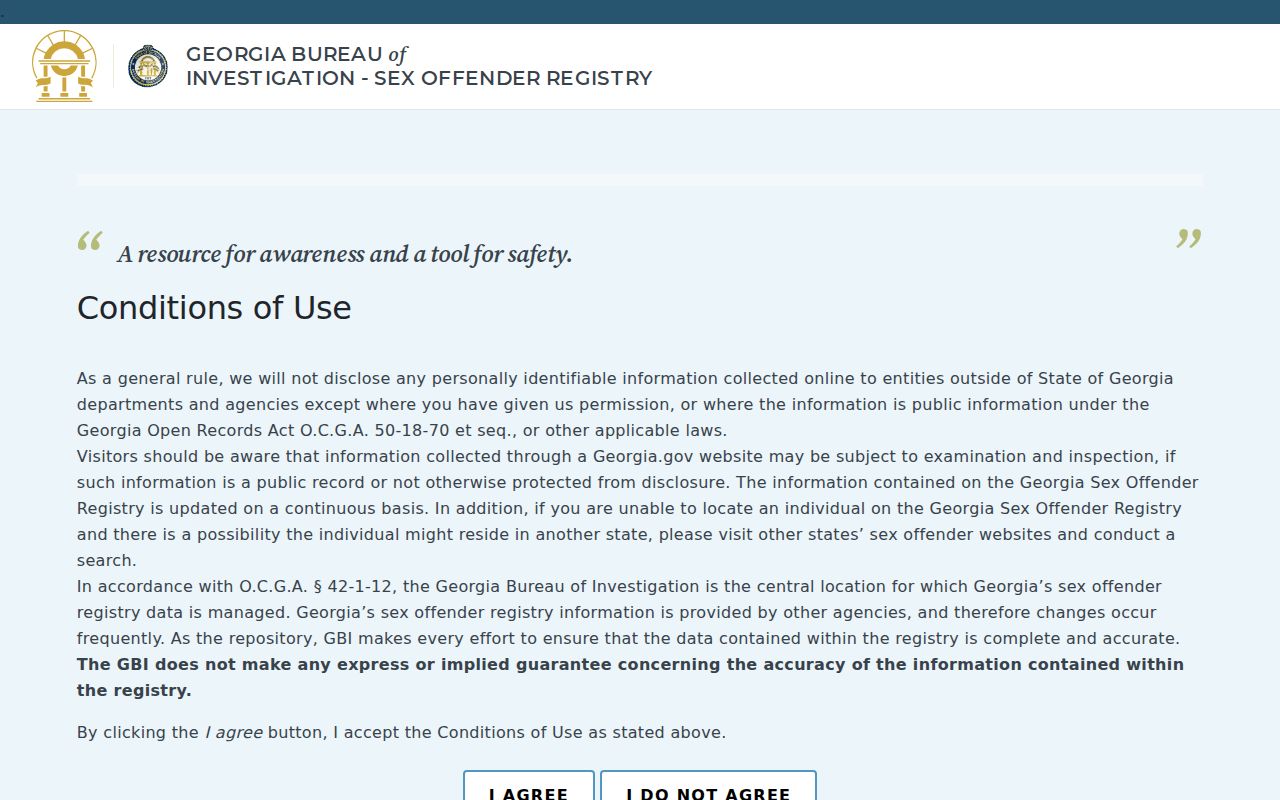
This screen makes clear that registry results require context rather than a quick conclusion from a name. Accepting the notice opens the public search, but it does not turn the database into a certified identity record. Save enough profile detail to explain a concern when calling the sheriff or GBI.
How to Search the Georgia Sex Offender Registry
Search in a deliberate order so broad results do not obscure the right Hancock County record. GBI says the database is updated continuously or daily as agencies provide data, yet a profile can still lag a recent move or correction.
- Open the official registry and read the conditions of use before selecting “I agree.”
- Use the available location or name route and narrow the result to Hancock County or Sparta when the interface permits.
- Compare the profile photograph, aliases, date or age information, physical descriptors, and address before treating a result as a match.
- Check the offense, compliance status, and risk classification, then contact the Hancock sheriff or GBI if the information appears wrong.
The captured research did not reliably extract every state-interface label, so no unsupported fields are claimed. The verified national layer has the following fields:
| Search field | Type | Required | Use |
|---|---|---|---|
| Name | Text | Route-dependent | National person search through NSOPW |
| Location radius | Selection | Optional | Mobile choices of 1/4 mile, 1/2 mile, or 1 mile |
| Hancock location | Registry route | Varies | Use the Georgia registry after accepting its conditions |
Georgia Levels Are Not Tiers
Georgia's Level I and Level II labels describe risk assessments. They are not the federal SORNA tier system and do not create a simple ten-year, twenty-five-year, and lifetime chart. Calling them tiers can cause a serious reading error. The GBI risk-level resource explains the state classification framework.
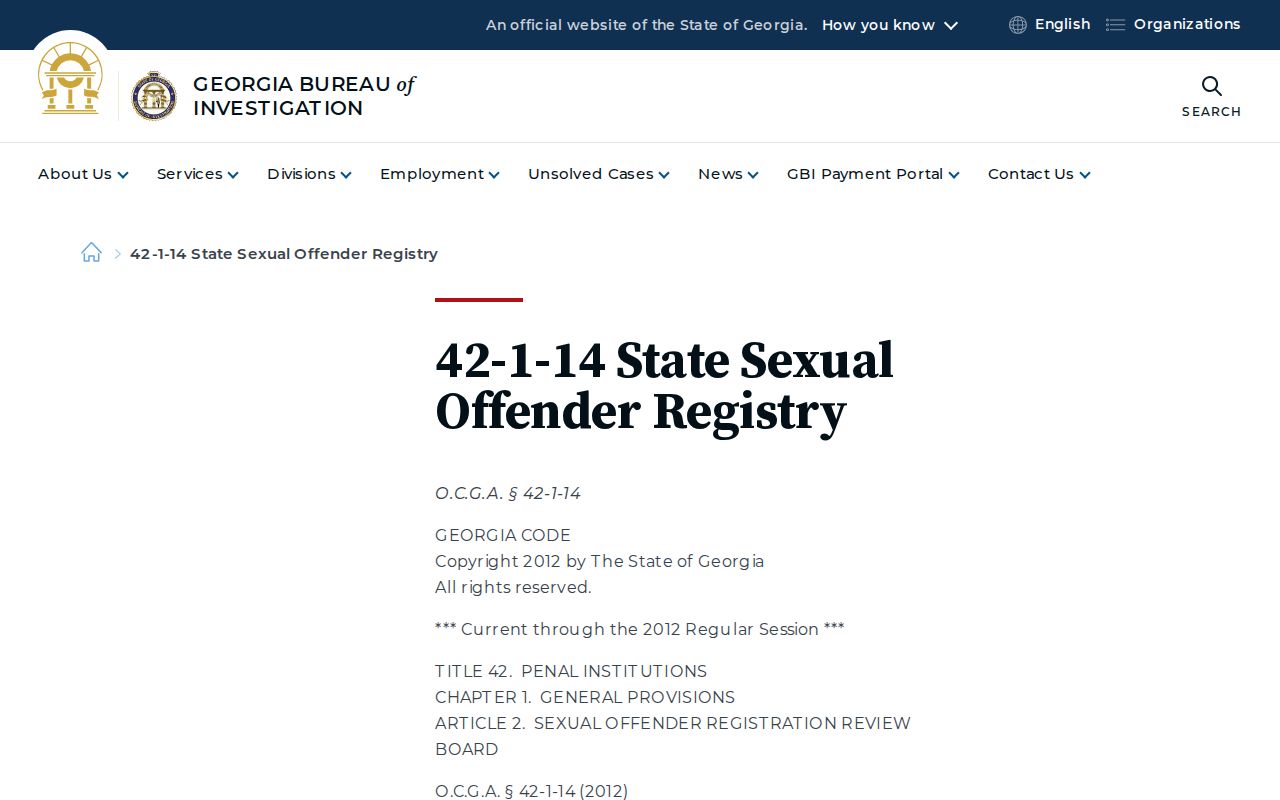
The classification screen supports a narrow conclusion: a Georgia risk level speaks to assessed risk, not the full term of registration. Duration depends on Georgia law, the offense, dates, and any court order. A profile with no level displayed should not be treated as proof that no duty or risk assessment exists.
Inside a Registry Profile
O.C.G.A. §42-1-12 supplies a useful inventory without reproducing any private registrant's values. A public Hancock County profile can include the categories below, though not every profile will display every field. The profile must be read as a changing agency record, not a permanent statement about a person's current location.
| Name and aliases | Reported legal name and other names tied to the registration record. |
|---|---|
| Photo and descriptors | Current photograph plus sex, race, age or date data, height, weight, hair, and eye information. |
| Addresses | Residence or sleeping location and, when applicable, work and school addresses. |
| Vehicle information | Reported vehicle details associated with the registration file. |
| Offense record | Offense and conviction information supporting registration. |
| Status and level | Compliance information and a Georgia risk classification when assigned. |
Use “can include” when discussing these fields. A missing field can reflect the profile's facts, the interface, or agency reporting. It does not support a broad claim about the person.
Beyond Hancock County with NSOPW
The National Sex Offender Public Website, or NSOPW, provides the official cross-state layer. It is especially useful when a person has lived outside Georgia or when a safety check concerns travel across county and state lines. NSOPW supplements the Georgia registry. It does not replace the Hancock sheriff's local registration role.
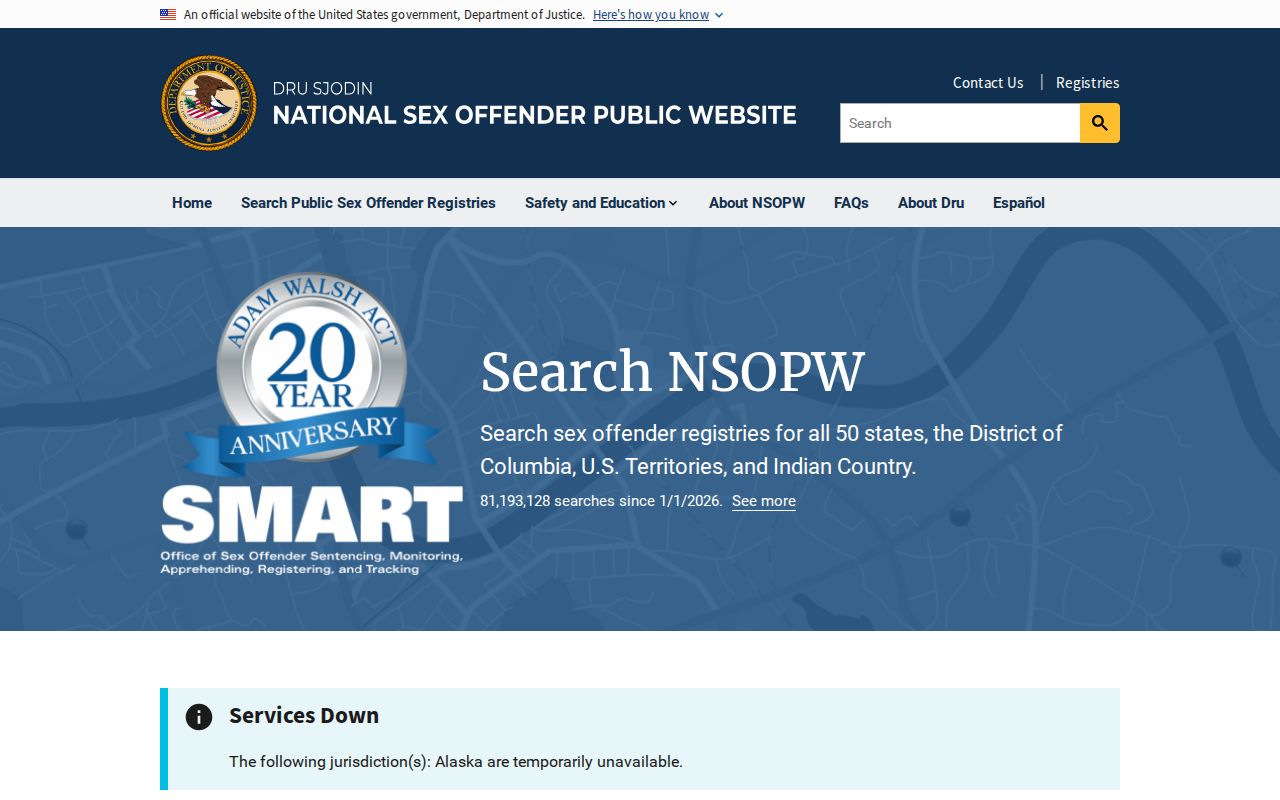
The national interface supports a name search, and its mobile location feature offers quarter-mile, half-mile, and one-mile radii. Those distances describe a search area, not Georgia residence restrictions or proof that every nearby record is current. Open the underlying jurisdiction profile and compare identifiers before acting on a result.
Note: A no-result response from either system does not prove that a person has no registration duty in another jurisdiction.
Georgia Registration Levels and Requirements
Georgia registration is generally a lifetime duty. Registrants usually report annually during the birthday month, while people designated as sexually dangerous predators report every six months. Certain required changes must be reported within 72 hours. The sheriff is the local point for registration and updates, while GBI maintains the public system.
| Georgia category | General duration | Reporting pattern |
|---|---|---|
| Registered offender | Generally lifetime, subject to law and court relief | Annual birthday-month renewal plus required changes within 72 hours |
| Level I | Risk classification, not a duration tier | Registration schedule still follows governing law |
| Level II | Risk classification, not a duration tier | Registration schedule still follows governing law |
| Sexually dangerous predator | Generally lifetime | Six-month reporting plus required changes |
The GBI registry FAQ supplies official explanations and search cautions.
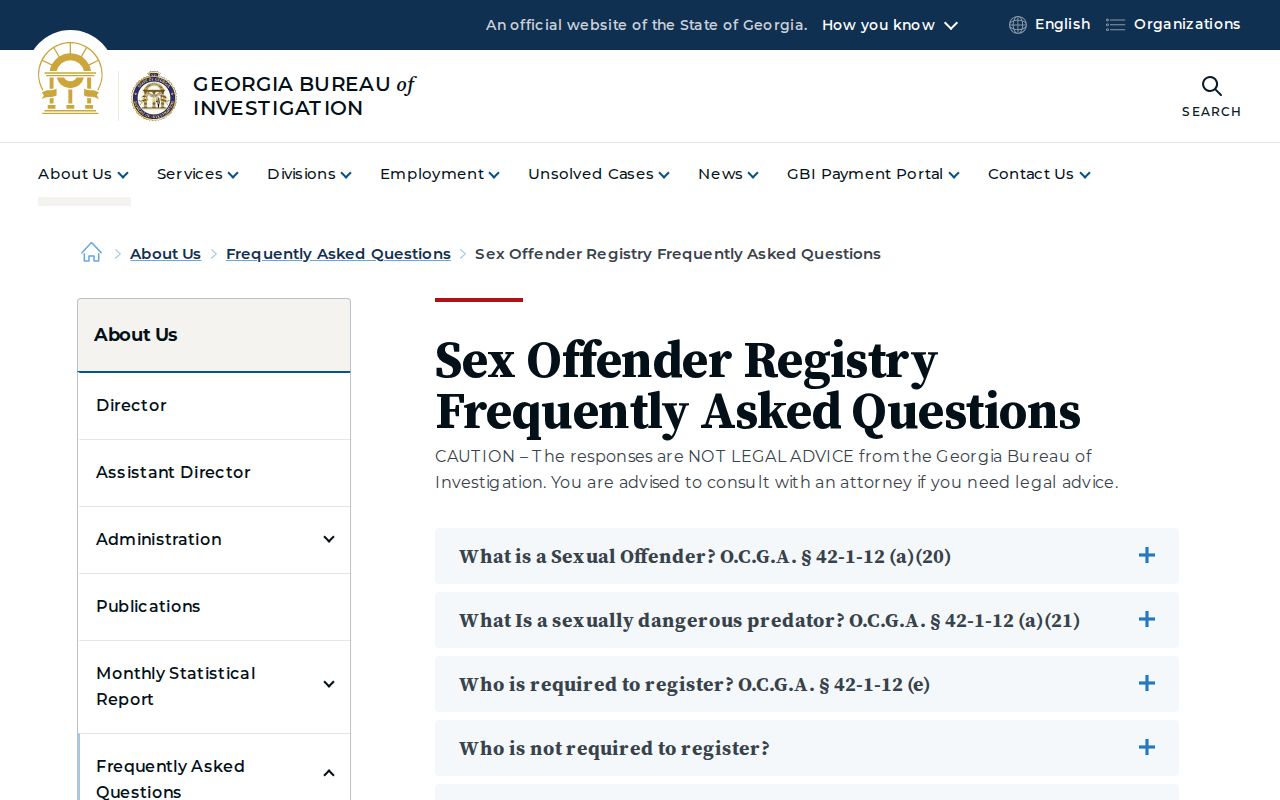
This official FAQ is the better source for changing statewide practice. Appointment details and a verification schedule for Hancock County were not published, so call 706-444-6471 before visiting the sheriff's administrative counter.
Correcting Hancock Registry Information
If a residence, status, or other field appears outdated, record the profile details and explain the specific discrepancy to the Hancock County Sheriff's Office. Sheriffs maintain local registration information, while GBI receives agency submissions and operates the central database. That split means the local office may need to verify a change before the state display catches up.
A useful report identifies the profile, the field in question, and why it appears stale without spreading the claim to neighbors or social media. The sheriff can check locally maintained registration facts. GBI can address how agency data appears in the central system. A public user cannot directly edit a profile, and an old display should not be treated as evidence that the named person failed to report. The county government site confirms the official local-government channel, while its county information page confirms the Sparta government location context.
Do not confront the person named in the profile. Contact the sheriff for a suspected local compliance issue or GBI for a central registry question. If the concern involves immediate danger, use the appropriate emergency channel rather than trying to investigate alone.
Release from Georgia Registration
O.C.G.A. §42-1-19 provides a court-petition route for some people seeking release from registration. The research notes pathways involving a ten-year period or a Level I classification, but eligibility turns on the full statute and individual case record. A denial may carry a two-year refiling interval. These rules should not be reduced to the label shown on a public profile.
A person reviewing their own duty should obtain the conviction and sentencing orders and seek qualified legal advice. The registry search is not a court docket, and the Hancock sheriff cannot replace the court that decides a petition. Likewise, a successful petition is a court event that may take time to reach every linked system. Keep the signed order and confirm the resulting status through official channels.
Community Notification and Lawful Use
Registry information supports personal safety and community awareness. It can inform a calm safety plan, a discussion with family members, or a request for official clarification. It must not become a tool for threats, harassment, vigilantism, or discrimination. GBI's conditions govern use of the public search, and O.C.G.A. §42-1-12 sets the Georgia registry framework.
Use registry data lawfully: Misusing Georgia registry information to harass, threaten, or intimidate a registrant or household can be a crime. Report a suspected violation to law enforcement instead of confronting anyone.
Verify the identity and current facts with the originating office before relying on a profile. Hancock County entries may change after sheriff or GBI updates, and the registry itself disclaims a guarantee of complete accuracy.